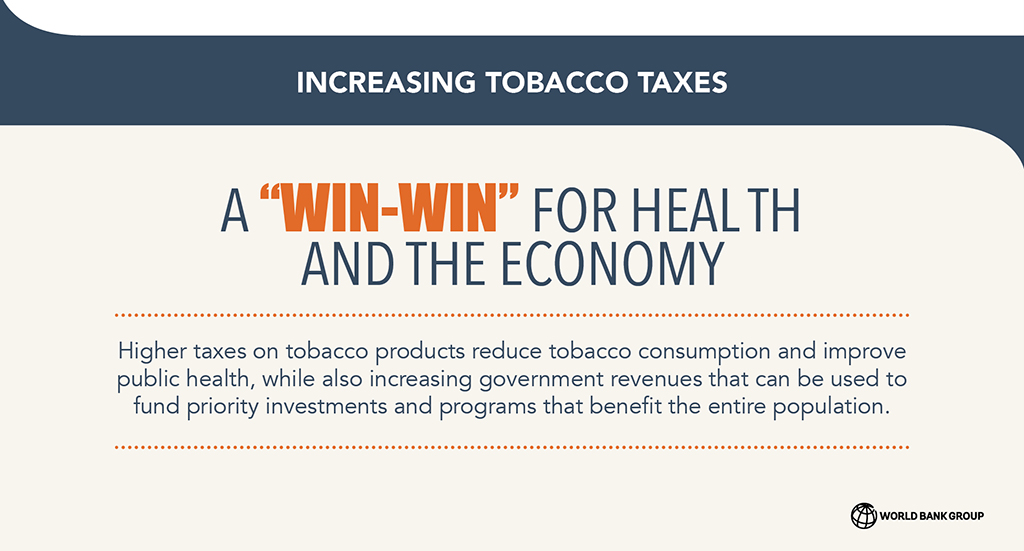
A new report by the World Health Organization (WHO) shares some good news: Six in 10 people worldwide are now protected by at least one of the WHO Framework Convention on Tobacco Control (FCTC)-recommended demand reduction measures, including taxation. The report, launched on the sidelines of the UN high-level political forum on sustainable development, also makes clear that raising taxes to increase tobacco product prices is the most cost-effective means to reduce tobacco use and prevent initiation among the youth. But it is still one of the least used tobacco control measures.
The facts about this global public health scourge are undisputable:
But we know what needs to be done and governments are acting. Governments are implementing “MPOWER”, six tobacco control measures in line with the WHO Framework Convention on Tobacco Control (FCTC). MPOWER includes:
The WHO report indicates that 43% of the world’s population (3.2 billion people) are now covered by two or more MPOWER measures at the highest level, nearly seven times the number covered in 2007. Eight countries, including five low- and middle-income ones, have implemented four or more MPOWER measures at the highest level: Brazil, Islamic Republic of Iran, Ireland, Madagascar, Malta, Panama, Turkey, and the United Kingdom of Great Britain and Northern Ireland.
Some additional findings are noteworthy:
What the World Bank Group is doing
As an institution, the Bank has long been committed to tobacco control as reflected in its unambiguous Operational Directive 4.76 of 1999 that mandates that the World Bank Group does not lend directly or provide credits, grants, or guarantees for tobacco production, processing, or marketing. The Bank’s policy advice and technical assistance support tobacco tax increases to protect the population from health risks and to mobilize additional domestic resources.
Over the past two decades, Bank teams have carried out substantial analytical work to build the global knowledge base on issues related to tobacco control.
In recent years, the Bank, in partnership with the Gates and Bloomberg Foundations, and in coordination with WHO, has supported countries in the design of tobacco tax policy reforms to raise prices, reduce consumption, and mobilize domestic resources in accordance with the 2015 Financing for Development Addis Ababa Action Agenda.
In addition to support provided to the reforms in Philippines in 2012, in Botswana in 2013, in Ghana in 2014, and in Peru in 2015, the Bank’s assistance to Armenia, Colombia, Moldova, and Ukraine contributed to the adoption of significant tobacco tax increases in 2016. The total population covered by these policy actions is about 250 million people.
Ongoing support is being provided in 2017 to an additional set of countries across regions, including Montenegro, where the government recently announced that tobacco taxes will be increased over the next 3 years in line with the European Union Tobacco Tax Directive’s target rates, and in Lesotho, as part of the 2017 budget presented by the new government to Parliament.
In moving the global tobacco control agenda forward, as the findings of the 2017 WHO report suggest, a dedicated focus by governments with support of the international community is required to raise tobacco taxes since it continues to be the least used tobacco control measure. This is of critical importance to make these deadly products unaffordable, reduce consumption among current smokers, and prevent smoking initiation among children and youth.
While health is the main objective, we also need to argue, on the basis of country evidence from across the world, that raising tobacco taxes can generate a significant fiscal benefit by helping to expand a country’s tax base and increase the budgetary capacity of governments to fund priority investments and programs that benefit the entire population.
Author: PATRICIO V. MARQUEZ