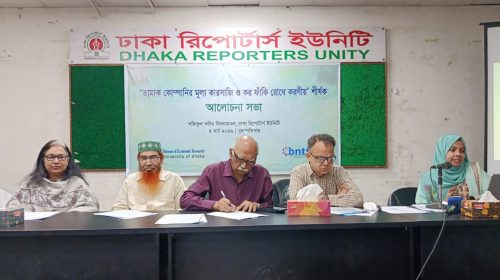

If the National Board of Revenue (NBR) agrees to the proposal recently submitted by multinational tobacco company British American Tobacco Bangladesh (BATB) to reduce the maximum retail price (MRP) of various cigarette brands, the government will lose more than Tk 2,200 crore in revenue. Accepting this proposal would also set an unprecedented and dangerous precedent in the history of tobacco tax policy — one that would benefit the tobacco company while harming both public health and revenue collection. The Bangladesh Network for Tobacco Tax Policy (BNTTP) disclosed this information in a press release on Thursday afternoon (20 August 2026).
The statement said BATB has proposed lowering the price of a pack of its Derby, Pilot, and Hollywood brand cigarettes from Tk 72 to Tk 63, and its Lucky Strike brand from Tk 108 to Tk 92. To this end, the company has requested amendment or clarification of the relevant provisions of Rule 118(a) of the Value Added Tax and Supplementary Duty Rules, 2016, and General Order No. 02/VAT/2026, so that manufacturers would gain “freedom” to set prices within the approved limits. Granting tobacco companies this kind of freedom would be a self-destructive decision with severe negative consequences for both revenue collection and public health.
If the BATB proposal is accepted, the government would lose approximately Tk 7.47 per pack of 10 sticks in the lower tier and Tk 13.28 per pack in the medium tier. According to recent years’ brand-wise sales data, the estimated sales volume of BATB’s Derby, Pilot, and Hollywood cigarettes is around 2,600 crore sticks, and Lucky Strike around 180 crore sticks. If permission is granted to cut the price of a 10-stick pack in the lower tier by Tk 9 (from Tk 72 to Tk 63) and Lucky Strike’s price by Tk 16 (from Tk 108 to Tk 92), the government would lose more than Tk 2,211 crore in revenue (Tk 1,972 crore from the lower tier and Tk 239 crore from the medium tier).
Expressing deep concern over BATB’s application, the statement noted that Section 3 of SRO No. 129-Law/2026/334, issued on 7 June 2026, clearly states that the maximum retail price of any cigarette brand already on the market cannot be reduced. There is no justification for relaxing this established policy safeguard for the sake of a single multinational company’s business forecasts and profit interests. If state tax policy is changed on the basis of one company’s sales strategy, other industries will in future have the opportunity to demand similar special privileges, which would undermine the stability of the overall tax structure.
The statement further noted that although NBR raised the MRP of lower-tier cigarettes by just Tk 2 (from Tk 60 to Tk 62) in the current fiscal year, BATB has been marketing cigarettes in this tier at Tk 72 for the past two years. Their demand for a price cut, based on speculative revenue-growth projections, is unreasonable and conflicts with the government’s public health protection policy and position. This is entirely a proposal aimed at protecting the company’s own commercial interests. On one hand, they have been earning thousands of crores of taka in profit by taking advantage of the phrase “and above,” used by the government in budget proposals for setting cigarette prices, to set higher prices; on the other hand, they are now seeking a policy change to cut prices as a market-capture strategy. This self-contradictory stance is driven purely by their own commercial interests.
BATB has speculated in its letter that reducing the price would increase sales and thereby boost revenue. However, there is no guarantee that the entirety of any increased sales would shift from the illegal market to the legal market. In reality, it is more likely that consumers within the legal market itself would simply shift toward relatively cheaper brands, meaning that even as total sales rise, the government’s actual revenue would fall further. Relaxing a specific legal safeguard based on one company’s self-interested market projections is extremely risky for state revenue policy and, at the same time, a direct violation of the law.
The statement added that BNTTP had proposed, for the current fiscal year, merging the lower and medium tiers with a minimum price of Tk 100 and a specific duty of Tk 4 per pack — a proposal that would have had a positive impact on both revenue and public health, alongside simplifying the price-tier structure. However, NBR did not accept that proposal and instead raised the price of lower-tier cigarettes by only Tk 2, to Tk 62 — an increase of just 3.3 percent, while the country’s current inflation rate stands at around 8.66 percent. As a result, the real purchasing power required to buy cigarettes has not actually decreased; rather, cigarettes have become cheaper relative to inflation. In this context, a proposal to lower prices further runs entirely counter to the goals of both public health and revenue policy.