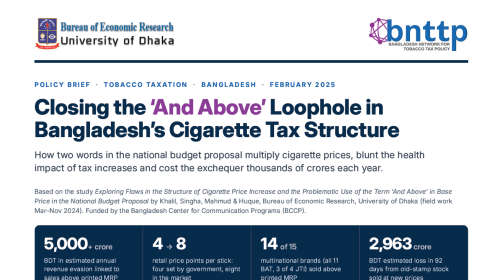
How two words in the national budget proposal multiply cigarette prices, blunt the health impact of tax increases and cost the exchequer thousands of crores each year.
Based on the study Exploring Flaws in the Structure of Cigarette Price Increase and the Problematic Use of the Term ‘And Above’ in Base Price in the National Budget Proposal by Khalil, Singha, Mahmud & Huque, Bureau of Economic Research, University of Dhaka (field work Mar–Nov 2024). Funded by the Bangladesh Center for Communication Programs (BCCP).
| 5,000+ crore
BDT in estimated annual revenue evasion linked to sales above printed MRP |
4 → 8
retail price points per stick: four set by government, eight in the market |
14 of 15
multinational brands (all 11 BAT, 3 of 4 JTI) sold above printed MRP |
2,963 crore
BDT estimated loss in 92 days from old-stamp stock sold at new prices |
| SUMMARY
Every year the budget raises cigarette prices to protect public health. The phrase “and above” attached to each tier’s base price lets manufacturers set their own higher prices, and the intended deterrent largely disappears. Bangladesh taxes cigarettes through four price tiers. Since FY 2018-19 every tier’s base price has been written as “X taka and above”, with no upper limit. Manufacturers have used that room, starting with British American Tobacco Bangladesh (BATB) in FY 2019-20 and followed by Japan Tobacco International (JTI) in FY 2024-25. A survey of 160 retail outlets in 16 cities and towns, plus 10 key informant interviews, shows three effects: prices fragment into many close points so smokers can trade down; per-stick prices exceed the printed Maximum Retail Price (MRP); and tier-based tax stamps (banderoles) make correct tax payment impossible to verify. |
What we recommend
1 Remove “and above” from the national budget proposal for every tier. 2 Declare exact prices: pack price and per-stick price, in the budget. 3 Issue price-specific banderoles, not stamps that differ only by tier colour. 4 Enforce MRP and digitise tax monitoring, with track-and-trace. WHO SHOULD ACT National Board of Revenue (budget drafting, stamp supply) · Ministry of Finance · National Consumer Rights Protection Directorate (MRP enforcement) · Ministry of Health (tobacco control). |
KEY INSIGHTS
| 01
Price rises only work if they stick A 10% price rise cuts smoking by about 7.1% (elasticity −0.71), more among low-income smokers. The effect is lost if smokers can step down to a cheaper brand. |
02
The gap is captured by industry The surplus above the printed price goes neither to government nor to retailers. BATB’s profit rose 28% in FY 2017-18 while production fell 3%, which the literature attributes largely to the multi-tier structure. |
03
Compliance is clearly possible Local brands and JTI’s LD sell at or near their printed prices with retailer margins intact. The abuse is a choice by multinational firms enabled by loose wording, not a market necessity. |
Prices were once fixed per tier. Over a decade the budget moved to open-ended base prices, and manufacturers learned to use the space above them.
| FY 2011-12
Fixed price bands in every tier; open-ended only at the top |
FY 2015-16
“And above” replaces an older term in the premium tier only |
FY 2016-17
Medium tier abolished; “and above” in all tiers but the lowest |
FY 2018-19
Four tiers return, all with “and above”; no new prices seen yet |
FY 2019-20
BATB launches “Royals” above the base price; others follow |
| Brands priced above the government base using “and above”
Number of brands per fiscal year, as reported in the study (Fig. 3). BAT first used the clause in FY 2019-20; JTI joined in FY 2024-25. |
Government price vs. company price, 20-stick packs (FY 2024-25)
The budget set four base prices. Manufacturers printed and sold at nine or more. |
Four ways the loophole works against policy goals
| 1 It multiplies price points
With four tiers there should be four per-stick prices (BDT 5, 7, 12, 16). The market has eight (5, 6, 7, 8, 10, 13, 18, 20) and 21 different pack prices. |
2 It shrinks the gap between brands
Gaps of BDT 2 to 5 between tiers become BDT 1. After a price increase a smoker can step to a cheaper brand, often from the same company, and keep smoking. |
| 3 It permits fractional per-stick prices
A 20-stick Benson pack printed at BDT 324 implies BDT 16.20 a stick; consumers pay BDT 18. With no coins in circulation, retailers round up and the difference stays outside the tax base. |
4 It lets companies steer the market
Price-list posters, supplied by the companies, appeared in 98 of 160 outlets (61.3%) and dictate per-stick prices above the pack price. |
Case in point: Lucky Strike, the most sold medium-tier brand
| BDT 140
Price set by government for a 20-stick pack, medium tier → |
BDT 176
Price set by BATB under “and above”, 26% higher → |
BDT 10
Per-stick price, unchanged since FY 2021-22 → |
BDT 190.13
Average retail price per pack, 8.0% above the printed MRP |
Experts interviewed in the study describe the term as vague, open-ended and favourable to the industry. One NBR official: every year prices are raised to protect public health, “but the term ‘and above’ minimizes the impact on consumers.”
160 retail outlets in public places across 16 cities and towns (eight divisional cities plus one district town per division), surveyed March–November 2024, and 10 key informant interviews.
| Four government price points became eight in the market |
Cigarettes are sold above the printed maximum retail price, in every tier
| TIER | BRAND | GOVT BASE, 20s | PRINTED MRP | AVG. RETAIL PRICE | ABOVE MRP |
| Premium | Alchemy (BAT) | 320 | 360 | 400.00 | +11.1% |
| Premium | Benson (BAT) | 320 | 324 | 344.20 | +6.2% |
| Medium | Lucky Strike (BAT) | 140 | 176 | 190.13 | +8.0% |
| Medium | Star (BAT) | 140 | 144 | 155.89 | +8.3% |
| Medium | Camel (JTI) | 140 | 140 | 153.02 | +9.3% |
| Low | Royals (BAT) | 100 | 108 | 117.23 | +8.6% |
| Low | London Cut (BAT) | 100 | 114 | 120.00 | +5.3% |
| Low | Hollywood (BAT) | 100 | 100 | 113.19 | +13.2% |
Prices in BDT for 20-stick packs, from the retailer survey (FY 2024-25). “Above MRP” = average retail selling price relative to the printed MRP. Selected brands; source: study Sections 4.2–4.3. Local brands LD (JTI) and Prime (Akij) were sold at or close to printed prices, showing that compliance is feasible.
The retail picture
|
Old stamps, new prices
More than four months after the 6 June 2024 budget, old-banderole stock was still sold at new prices without the required new price stickers. Prices were raised again on top. Per-stick prices moved from BDT 15.5–16 to 18–20 (premium) and from 4.5 to 6 (low tier). Estimated loss: BDT 2,963 crore over 92 days. After the research team raised it, NBR issued payment notices of BDT 210.86 crore to BAT and nearly BDT 13 crore to JTI. |
Four measures that reinforce one another. The first two can be written into the next budget proposal; the other two require NBR administrative action.
|
WHAT THE EXPERTS SAID “And above” makes it difficult for the government to raise taxes. Without it, calculating specific prices would be easier, evasion would be prevented and consumers could identify fair prices. It must be removed, and specific taxation applied. |
| Beyond the budget text: the direction experts favour
Interviewees from the NBR and tobacco-control community also called for replacing the ad-valorem system with a specific (per-stick) tax and a simplified two-tier structure. A specific tax does not depend on declared prices, which removes the incentive to manipulate them. This is a medium-term reform; removing “and above” is the immediate step. |
Funding. This research was funded by the Bangladesh Center for Communication Programs (BCCP).
Evidence base. Mixed-methods cross-sectional study, March–November 2024: semi-structured survey of 160 retail outlets (10 per city, 16 cities and towns) and 10 key informant interviews (5 tobacco-control experts, 3 NBR officials, 2 economists). Findings refer to the FY 2024-25 budget. Revenue figures are study estimates. Full study: Khalil M.I., Singha S.K., Mahmud H.M.M., Huque R. Exploring Flaws in the Structure of Cigarette Price Increase and the Problematic Use of the Term ‘And Above’ in Base Price in the National Budget Proposal. Bureau of Economic Research, University of Dhaka.
To download the full policy brief, please click here. Policy_Brief_And_Above_Cigarette_Tax_Bangladesh